Where to Invest in Padel in 2026: Emerging Markets for New Padel Clubs

Padel is no longer an emerging sport.
It is becoming a global sports infrastructure market.
In 2026, approximately 38 million people play padel across 178 countries and territories, supported by around 85,000 courts and 27,000 clubs worldwide, according to the International Padel Federation (FIP).
For investors, however, these numbers raise a more important question:
Where should you build the next padel club?
The answer is not necessarily the country with the most players or the largest number of existing courts.
In mature markets, competition for players, suitable land and premium locations can already be significant. Emerging markets may offer a different opportunity: growing awareness of the sport combined with comparatively limited court infrastructure.
For investors, developers, hotels and sports clubs planning their next project, understanding this difference is essential.
Padel Investment Is Becoming a Global Opportunity
Europe remains the centre of the global padel industry, but growth is becoming increasingly international.
FIP's World Padel Report 2025 recorded more than 77,000 courts worldwide by mid-2025 and showed particularly strong expansion outside padel's traditional markets. Over an 18-month period, court numbers increased approximately 99% in Central and North America, 47% in Africa and 45% in Asia.
By June 2026, FIP reported approximately 85,000 courts globally.
This creates two very different investment environments.
In established markets, investors may compete through premium facilities, location, service quality and club experience.
In emerging markets, the opportunity may be to establish a strong position before court density reaches mature-market levels.
1. The Balkans: Europe's Next Padel Expansion Zone
Spain and Italy demonstrate what a mature European padel ecosystem can look like.
But Southeast Europe presents a different opportunity.
Countries such as:
Serbia, Romania, Bulgaria, Croatia, Slovenia, Albania, Montenegro, Bosnia and Herzegovina, North Macedonia and Kosovo
are increasingly interesting for new padel developments.
Why?
Geographic proximity to established European markets helps introduce the sport, while tourism, urban development and an established culture of football, tennis and other sports provide potential customer bases.
The opportunity is particularly interesting around capital cities, coastal tourism destinations and premium residential developments.
Projects do not necessarily need to begin with ten courts.
A strategically designed two- to four-court facility can establish a market, develop a player community and create the foundation for future expansion.
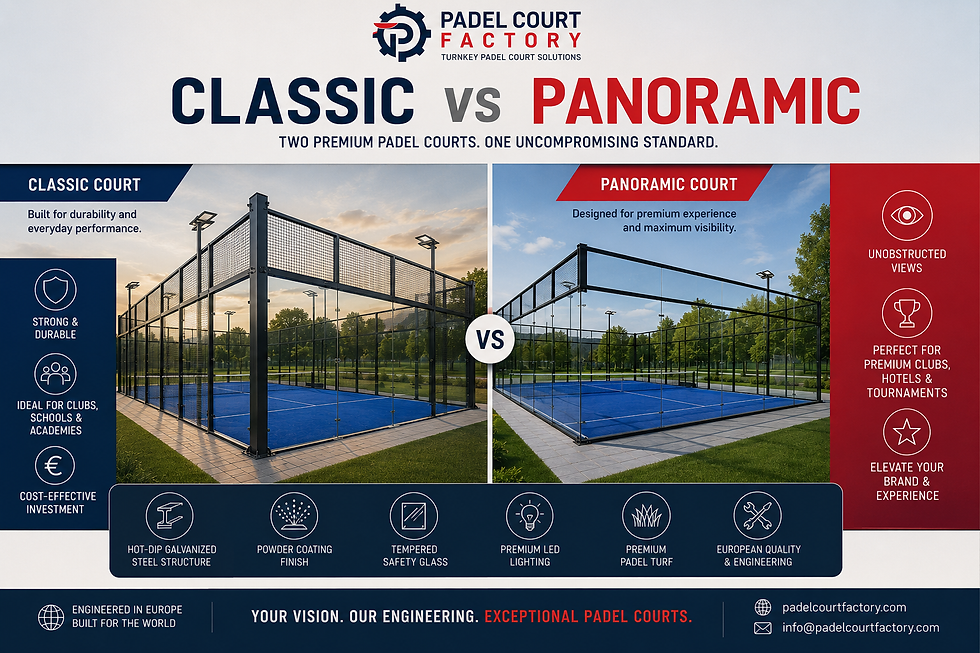
For larger projects, combining Classic courts with a Panoramic centre court can provide both operational capacity and a premium visual focal point.
2. Central and Eastern Europe: Scale Meets Untapped Demand
Central and Eastern Europe deserves particular attention.
Markets such as Romania, Bulgaria, Poland, Hungary, Czechia and Slovakia combine significant urban populations with improving sports and leisure infrastructure.
Europe already represents the world's largest padel ecosystem. FIP reported more than 45,000 courts and 18 million players across the continent in late 2025.
But that infrastructure is not evenly distributed.
This is important.
An investor should not simply ask:
"Is padel popular in Europe?"
The better question is:
"How many suitable courts exist within my actual catchment area?"
A city with growing awareness of padel but limited quality facilities may offer significantly more potential than a famous padel destination with intense competition.
3. Middle East: Premium Padel Is Becoming Part of Lifestyle Development
The Middle East represents another type of opportunity.
Here, padel can be integrated into:
Premium sports clubs
Residential compounds
Hotels and resorts
Private developments
Academies
Lifestyle destinations
Mixed-use real estate projects
Saudi Arabia is already among the world's leading countries by installed padel infrastructure in FIP's 2025 data.
The wider region also continues to attract investment interest as padel evolves into a professional sports and leisure asset. Industry analysis in 2026 identifies the Middle East among the emerging regions attracting new investment capital.
For these projects, the court itself often becomes part of the architecture.
That makes Panoramic courts, premium turf, professional lighting and custom finishes particularly relevant.
4. Africa: One of the Most Interesting Long-Term Markets
Africa deserves much more attention from the global padel industry.
According to FIP's 2025 report, the continent recorded approximately 47% growth in court numbers over the measured 18-month period.
South Africa and Egypt already demonstrate that the sport can develop significant local markets.
But the next opportunity extends beyond those countries.
Potential growth markets include:
Morocco, Ghana, Senegal, Côte d'Ivoire, Kenya, Rwanda, Tanzania and other rapidly developing urban centres.
The business model may also be different from Europe.
A padel project can become part of a broader sports destination combining:
Football
Tennis
Fitness
Café and hospitality
Academies
Events
Corporate activities
For developers, that makes padel not merely a standalone sport but an additional revenue-generating component of a larger facility.
5. Asia: A Market Moving Quickly
Asia should also be on investors' radar.
FIP reported that the continent added more than 600 courts between April 2024 and October 2025 in one recent analysis, while padel continues to gain institutional recognition across Asian sport.
Padel will also feature as a medal sport at the Aichi-Nagoya 2026 Asian Games, another indication of its growing visibility across the continent.
Markets including the Gulf, Southeast Asia and selected major Asian cities therefore deserve long-term attention.
But climate becomes especially important.
Heat, humidity, rainfall and UV exposure can influence:
Steel protection
Turf selection
Drainage
Court orientation
Lighting
Covered versus outdoor design
A court designed for one European climate should not simply be replicated everywhere.
What Makes a Good Padel Market?
A country with few courts is not automatically a good investment.
Likewise, a country with many courts is not automatically saturated.
Before investing, we recommend analysing five areas.
1. Local Demand
Is there an existing racket-sports community?
Tennis players often provide an important early customer base, but demographics, expatriate communities, tourism and corporate populations can also influence demand.
2. Existing Competition
Analyse the number of courts within the realistic driving radius of the proposed facility.
Then evaluate their quality.
Poor-quality existing infrastructure can sometimes represent an opportunity rather than competition.
3. Land and Accessibility
A commercially successful club needs more than available land.
Parking, road access, visibility and proximity to residential or commercial areas can strongly influence utilization.
4. Climate
Outdoor courts in Scandinavia, the Balkans, the Gulf and West Africa face completely different environmental conditions.
Engineering decisions should reflect the actual location.
5. Revenue Potential
Court rental is only one possible revenue stream.
A professionally planned facility can also generate income from:
coaching, academies, memberships, tournaments, corporate events, sponsorship, equipment rental, retail and food & beverage.
Build for the Market, Not Just the Sport
This may be the most important principle for a new padel investment.
Do not copy a successful club in Madrid, Dubai or Stockholm and assume the same model will work in your city.
The number of courts, court model, clubhouse, pricing strategy and supporting facilities should reflect the local market.
A community project may prioritize Classic courts and operational efficiency.
A luxury resort may prefer one or two Panoramic courts.
A commercial club could combine both:
3 Classic Courts + 1 Panoramic Centre Court
The right configuration depends on the business—not simply the sport.
From Court Supplier to Project Partner
As padel expands into new markets, international projects require more than supplying steel and glass.
Engineering, manufacturing, turf, lighting, logistics and installation must work as one coordinated system.
At Padel Court Factory, our approach is built around the complete project:
Concept → Engineering → Manufacturing → Turf → Lighting → Logistics → Installation Support
This allows us to adapt the solution to different markets, climates and investment models.
Whether the project is a private court, commercial club, hotel, academy or multi-sport complex, the objective remains the same:
build the right court for the right market.
Where Will the Next Padel Market Emerge?
Padel's international development is accelerating.
The sport now has a presence across 178 countries and territories, while its international competitive footprint continues to expand.
The biggest opportunity therefore may not be in following today's largest padel markets.
It may be in identifying tomorrow's.
For investors, developers and sports facility operators, the winning strategy is increasingly about combining market intelligence with the right location, business model and infrastructure.
The next major padel destination may still be waiting to be built.
WhatsApp: +90 532 469 61 35


Comments