Classic, Panoramic or Both? How to Choose the Right Padel Courts for Your Club

Planning a new padel club involves dozens of decisions.
Location. Land. Number of courts. Clubhouse. Parking. Turf. Lighting. Changing rooms. Coaching areas. Café. Membership model.
But one decision usually comes very early:
Should your padel club use Classic courts, Panoramic courts — or a combination of both?
There is no universal answer.
A Panoramic court is not automatically the right choice simply because it offers a more premium appearance. Likewise, choosing a Classic court does not mean compromising on professional play.
The right configuration depends on how the club will operate, who will use it, how many courts you plan to build and what kind of experience you want to create.
For many commercial padel clubs, the most effective answer may actually be:
both.
Let's look at why.
First: What Is the Real Difference Between Classic and Panoramic Padel Courts?
Both court types are designed around the same fundamental playing dimensions and requirements.
Players should experience a professional playing environment regardless of whether they enter a Classic or Panoramic court.
The main difference is therefore not simply about the game itself.
It is about the structural concept surrounding the game.
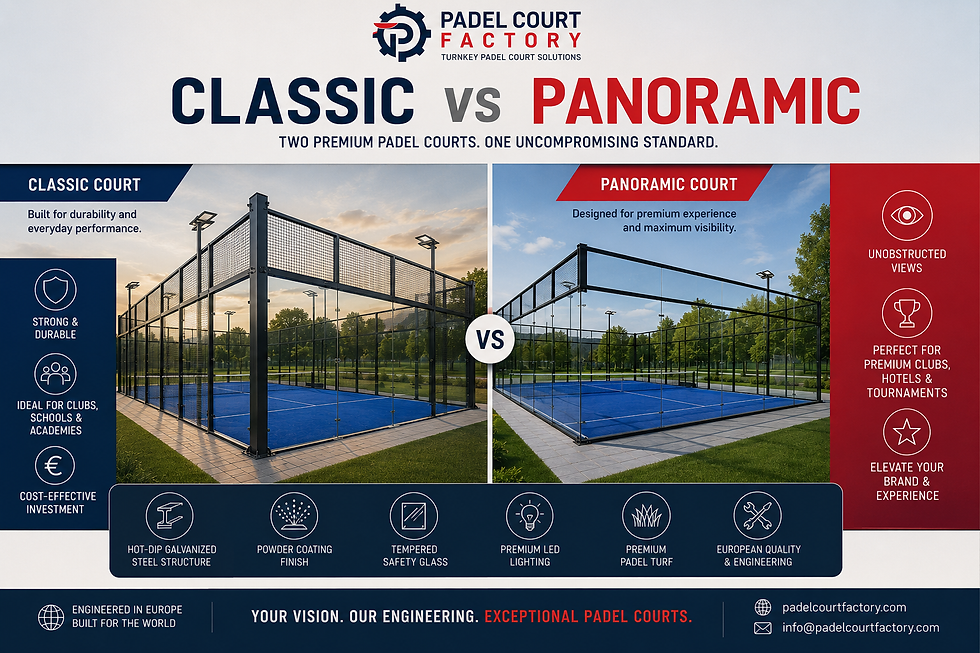
Classic Padel Court
A Classic court uses a more visible structural framework around the playing area.
The steel construction becomes a stronger part of the enclosure, creating a robust and functional court system.
This makes Classic courts particularly suitable for facilities where the priorities include:
High daily utilization
Training
Coaching
Academies
Membership play
Municipal facilities
Schools and universities
Multi-court commercial clubs
The Classic court is essentially the workhorse of a padel facility.
What Is a Panoramic Padel Court?
A Panoramic court reduces visual obstruction around key glass areas.
The result is a cleaner and more open appearance.
This creates better visibility for spectators, photographers, cameras and people watching from surrounding hospitality areas.
That makes Panoramic courts especially attractive for:
Centre courts
Tournament matches
Premium clubs
Hotels and resorts
VIP environments
Exhibition matches
Sponsorship-focused courts
Social media content
Broadcast-oriented facilities
A Panoramic court does more than provide a playing area.
It can become the visual centrepiece of the club.
Classic vs Panoramic: What Actually Matters to a Club Owner?
For a club investor, comparing court types only by technical specifications misses the larger question.
You are not buying individual courts. You are designing a padel business.
That means the decision should consider how each court contributes to the entire facility.
Consideration | Classic Court | Panoramic Court |
Professional play | ✓ | ✓ |
Daily club usage | Excellent | Excellent |
Training & academy | Excellent | Excellent |
Multi-court facilities | Highly suitable | Suitable |
Spectator visibility | Good | Excellent |
Tournament centre court | Suitable | Excellent |
Premium visual impact | Good | Excellent |
Hotel / resort positioning | Suitable | Highly suitable |
Broadcasting / content | Good | Excellent |
Club focal point | Functional | Strong |
Sponsorship visibility | Good | Excellent |
The important point is that these are not competing products in every situation.
They can perform different jobs inside the same club.
When Does an All-Classic Padel Club Make Sense?
There are many projects where using Classic courts throughout the facility is a logical choice.
Imagine a four-court community club.
Its business model is primarily based on:
Hourly bookings
Memberships
Coaching
Children's programs
Amateur leagues
Academy training
The objective is to maximize court utilization and build a strong local player community.
In this situation, four professional Classic courts can create a highly effective facility.
The investor can concentrate resources on other elements of the club:
better turf, professional lighting, clubhouse quality, changing rooms, landscaping, parking and customer experience.
A club does not become premium simply because every court is Panoramic.
The entire facility creates the experience.
When Does an All-Panoramic Club Make Sense?
Now consider a completely different project.
A luxury resort is adding two padel courts overlooking the sea.
The courts will be visible from the hotel, restaurant and pool area.
Guests may photograph them.
Corporate events may use them.
The architecture of the sports facility is part of the hotel's overall visual identity.
Here, Panoramic courts can make considerably more sense.
The court becomes part of the destination.
The same logic may apply to:
Luxury residential developments
Private clubs
Premium rooftop facilities
Beach resorts
High-end wellness clubs
Flagship padel venues
In these environments, visual integration has commercial value.
But What About a Commercial Padel Club?
This is where the decision becomes more interesting.
Suppose you are planning a six-court commercial padel club.
Do all six courts need to be Panoramic?
Not necessarily.
Do all six need to be Classic?
Again, not necessarily.
Instead, you can assign different roles to different courts.
For example:
4 Classic Courts + 2 Panoramic Courts
The Classic courts handle much of the club's everyday activity:
Training
Regular bookings
Academy sessions
Coaching
League matches
The Panoramic courts can be positioned for:
Important matches
Tournaments
Finals
VIP bookings
Sponsor activations
Events
Content creation
Now the facility has both operational capacity and premium positioning.
The Centre Court Strategy
One of the strongest configurations for a new padel club is surprisingly simple:
Several Classic Courts + One Panoramic Centre Court
Consider a four-court project:
Court 1 — ClassicCourt 2 — ClassicCourt 3 — ClassicCourt 4 — Panoramic Centre Court
Instead of treating all four courts identically, the club creates a hierarchy.
The Panoramic court can be positioned in the most visible location.
Perhaps directly opposite the clubhouse.
Perhaps beside the café terrace.
Perhaps surrounded by spectator seating.
Perhaps positioned where sponsors receive maximum exposure.
That court becomes the club's show court.
Why Does a Centre Court Matter?
A centre court gives the facility something ordinary multi-court layouts often lack:
a focal point.
Imagine a tournament final.
Players compete on the Panoramic court.
Spectators gather around it.
The café terrace overlooks the match.
Sponsor branding surrounds the court.
Photos and videos are produced from unobstructed viewing angles.
The match becomes an event rather than simply another booking.
The other courts continue performing their primary operational function.
This is why court selection should be considered during the master planning stage, not after the facility layout has already been completed.
Example Court Configurations
There is no fixed formula, but several configurations can provide useful starting points.
2-Court Boutique Facility
Option A:
2 Classic
Suitable for a straightforward commercial, residential or training-focused project.
Option B:
1 Classic + 1 Panoramic
Provides operational flexibility and a premium feature court.
Option C:
2 Panoramic
Particularly attractive for hotels, resorts and premium private facilities.
4-Court Commercial Club
A very interesting configuration is:
3 Classic + 1 Panoramic
The three Classic courts provide the operational backbone.
The Panoramic court becomes the centre court.
This configuration can work particularly well for growing clubs that want both strong daily utilization and a premium identity.
6-Court Padel Club
Possible configuration:
4 Classic + 2 Panoramic
One Panoramic court can serve as the main centre court.
The second can support tournaments, premium bookings and simultaneous events.
This also gives the club greater flexibility when organizing competitions.
8-Court or Larger Facility
At this scale, court selection should become part of the overall zoning strategy.
For example:
6 Classic + 2 Panoramic
or
5 Classic + 3 Panoramic
The right ratio depends on the commercial concept.
A large academy may favour more Classic courts.
A destination club built around tournaments and hospitality may justify a greater Panoramic presence.
There is no reason to force every large facility into the same formula.
Think About Where the Panoramic Court Is Located
Choosing a Panoramic court is only half the decision.
Where you put it matters just as much.
A premium centre court hidden behind three other courts loses much of its potential.
Ideally, the Panoramic court should interact with important parts of the facility.
These may include:
Main entrance
Reception
Café
Restaurant
Terrace
VIP lounge
Spectator seating
Sponsor areas
Event zone
This creates visual connections between padel and the social areas of the club.
The court becomes part of the architecture.
Think About Spectators Before Construction
Another common planning mistake is designing spectator areas after the courts have already been positioned.
Instead, ask:
Where will people watch the most important match?
Then design around that answer.
A Panoramic centre court combined with properly planned spectator circulation can transform tournament days.
You may want:
Small tribunes
Standing areas
Café seating
Elevated viewing
VIP seating
Sponsor zones
Camera positions
These requirements should influence the master plan from the beginning.
Classic Courts Are Not "Budget Courts"
This distinction is important.
Classic should not automatically be interpreted as economy, while Panoramic means professional.
That is the wrong comparison.
A professionally engineered Classic court can be built with high-quality:
Galvanized steel
Tempered safety glass
Artificial turf
Lighting
Coating systems
Fasteners
Accessories
The difference is primarily the structural and visual concept.
A Classic court can therefore be entirely appropriate for a high-quality professional padel club.
Panoramic Does Not Automatically Mean Better ROI
The same principle applies in reverse.
Installing Panoramic courts throughout a project does not automatically create a more profitable club.
Return on investment depends on many factors:
Location
Occupancy
Court pricing
Membership model
Coaching revenue
Operating costs
Tournaments
Food & beverage
Sponsorship
Customer retention
A beautiful court with low occupancy is still an underperforming asset.
Court selection should therefore support the business model rather than replace it.
Use the Investment Budget Strategically
Suppose the project budget allows you to choose between:
six Panoramic courts with basic supporting facilities
or
four Classic + two Panoramic courts with a stronger clubhouse, café, spectator zone and landscaping.
The second concept may sometimes create a more complete commercial environment.
Why?
Because customers experience the entire facility.
They remember:
the arrival,
the reception,
the changing room,
the court,
the lighting,
the café,
the social atmosphere,
and the people.
The court is the heart of the business.
But the club is the experience.
Don't Forget the Turf
Classic versus Panoramic receives a lot of attention because the structural difference is visually obvious.
But players interact directly with another component every second of the match:
the turf.
Turf selection affects, so Globo Turf provides you the best for:
Ball behaviour
Player movement
Comfort
Consistency
Maintenance
Visual quality
For this reason, investors should avoid spending the entire premium budget on the visible steel and glass structure while treating the playing surface as an afterthought.
A balanced project considers both architecture and performance.
Lighting Matters Too
The same applies to lighting.
Professional lighting affects:
Evening bookings
Player comfort
Ball visibility
Photography
Video
Tournament presentation
For commercial clubs, every additional playable evening hour can contribute to facility utilization.
Lighting is therefore not simply an accessory.
It is part of the operating model.
Choose Courts According to Revenue Zones
A useful way to design a larger padel facility is to stop thinking only in terms of courts.
Think in terms of zones.
High-Utilization Zone
Classic courts can serve:
Regular bookings
Academy
Coaching
Training
Membership play
Premium / Event Zone
Panoramic courts can serve:
Centre court
Finals
VIP matches
Events
Sponsors
Media
Social Zone
Connect the premium court with:
Café
Terrace
Lounge
Spectator seating
Now the club begins to operate as one integrated commercial environment.
What About Padel Academies?
For a dedicated padel academy, Classic courts can provide a strong foundation.
Academies prioritize:
Training capacity
Repeated daily usage
Coaching
Player development
Group lessons
Operational efficiency
But even an academy can benefit from one Panoramic court.
Why?
Because academies also organize:
Junior tournaments
Finals
Demonstration matches
Sponsor events
Player assessments
Content
A Panoramic show court can therefore complement a training-oriented Classic court configuration.
What About Hotels and Resorts?
Hotels approach the decision differently.
For them, padel may be both a sports amenity and part of the property's visual experience.
Guests see the court before they play on it.
That increases the importance of:
Architecture
Landscaping
Court colour
Glass visibility
Lighting
Surrounding social areas
For a one- or two-court luxury hotel project, Panoramic courts may therefore be particularly attractive.
For a large resort sports centre with six or eight courts, however, a mixed configuration can again become relevant.
What About Tournaments?
If tournaments are part of the business plan, plan for them before construction.
A tournament-oriented club should consider:
Centre Court → Spectators → Players → Officials → Sponsors → Media → Hospitality
A Panoramic centre court can be particularly useful because of its viewing characteristics.
But the tournament still requires additional courts.
Classic courts can provide substantial match capacity while the Panoramic court hosts marquee matches and finals.
Again, both court types can complement one another.
A Simple Decision Framework
Before choosing your courts, answer these questions:
How many courts will the facility have?
Is the project primarily commercial, academy, hotel or private?
Will you host tournaments?
Do you need a centre court?
Will spectators regularly watch matches?
Is broadcasting or social media content important?
Will sponsors use the facility?
How important is architectural appearance?
What proportion of usage will be coaching and everyday bookings?
Could the facility expand later?
Once these questions are answered, the correct configuration usually becomes much clearer.
So, Classic or Panoramic?
The answer does not have to be one or the other.
Choose Classic courts when operational capacity, training, frequent daily use and efficient multi-court planning are central to the project.
Choose Panoramic courts when spectator visibility, premium architecture, tournaments, hospitality, sponsorship and visual presentation are particularly important.
And for many commercial padel clubs:
Choose both.
Use Classic courts as the operational backbone of the facility.
Use Panoramic courts strategically as centre courts and premium assets.
This creates a club where every court has a purpose.
Build the Club Before You Choose the Court
The best time to decide between Classic and Panoramic courts is not when requesting a quotation.
It is during facility planning.
Start with:
Business Model → Capacity → Master Plan → Court Mix → Supporting Facilities → Infrastructure → Construction
At Padel Court Factory, we can approach a project as a complete facility rather than simply a collection of courts.
From initial court configuration to engineering, manufacturing, turf, lighting, international logistics and installation support, the objective is to create the right solution for the project.
Because the real question isn't:
Classic or Panoramic?
It is:
What combination will make your padel club work best?
Planning a new padel facility?
Padel Court Factory can support your project from initial court configuration and engineering through manufacturing, international delivery and installation support.
Build the Game. From the Ground Up.
Padel Court Factory - export@padelcourtfactory.com - WhatsApp: +905324696135


Comments